PSSC Labs Announces Integration of Intel Omni-Path into HPC Solutions

By marketing@site-a.com

New fabric provides higher performance, lower cost and better support for current and future processors

LAKE FOREST, CALIFORNIA (PRWEB) MAY 30, 2017

PSSC Labs, a developer of custom HPC and Big Data computing solutions, today announced it has certified the Intel Omni-Path High Performance Fabric on its PowerWulf HPC solutions. Omni-Path is already a proven solution deployed and deployed in several high-performance computing instillations that are ranked in the Top 500 List. This additional option will continue to expand PSSC Lab’s wide array of high value, high performance HPC solutions.

For years, the Mellanox Infiniband has dominated high performance fabric in the parallel computing space. Intel’s Omni-Path architecture is a game changing technology that increases speed and performance, at a cost lower than the Mellanox counterpart. By integrating Intel Omni-Path Fabric into its PowerWulf solutions, PSSC Labs continues its mission of providing cutting edge solutions that push the boundaries of price and performance, while maintaining the absolute highest level of application support and system reliability.

“PSSC Labs is proud to offer our solutions with the latest Intel technology, providing our customers with the highest level of performance and stability,” said Alex Lesser, Vice President of PSSC Labs. “PSSC Labs is an Intel HPC Data Center Specialist and has been a Platinum Provider with Intel since 2009, and our knowledge and experience is what allows us to incorporate the best in Intel Technology with our leading turn-key, custom HPC solutions.”

Benefits of the Omnipath Processor compared to Mellanox Infiniband include: 

  • Omni-Path clusters have up to 9% higher application performance than Infiniband
  • Omni-Path is up to 33% less expensive than Infiniband
  • Omni-Path is compatible with applications currently supported by Infiniband
  • Direct connection to the CPU in Future generations of Intel Xeon and Phi processors, thereby eliminating the cost and latency of a host bus adapter.
  • Higher bandwidth support with up to 100 Gbps

PSSC Lab’s PowerWulf HPC solutions offer a reliable, flexible, high performance computing platform for a variety of applications in the following verticals: Design & Engineering, Life Sciences, Physical Science, Financial Services and Machine/Deep Learning.

Every PowerWulf HPC Cluster with Intel Omni-Path includes a three year unlimited phone / email support package (additional year support available) with all support provided by our US based team of experienced engineers. Prices for a custom built PowerWulf solution start at $20,000. For more information see https://www.site-a.com/solutions/hpc-cluster/.

Source: http://www.prweb.com/releases/2017/05/prweb14375915.htm

PSSC Labs Announces “Greenest” New Eco Blade Server Platform for High Performance Computing

By marketing@site-a.com

Most energy efficient server on the market offers power, performance, and energy savings of up to 46% per server

LAKE FOREST, Calif., May 22, 2017 /PRNewswire/ — PSSC Labs, a developer of custom HPC and Big Data computing solutions, today announced its new Eco Blade server platform, the most energy efficient high performance blade server on the market.

The Eco Blade is a unique server platform engineered specifically for high performance, high density computing environments – simultaneously increasing compute density while decreasing power use. Eco Blade offers two complete, independent servers within 1U of rack space. Each independent server supports up to 64 Intel® Xeon® processor cores and 1.0 TB of enterprise memory for a total of up to 128 Cores and 2 TB of memory per 1U.

There is no shared power supply or backplane, a unique design feature that translates to power savings of up to 46% on a per server comparison with servers of similar capabilities from leading brands. By lowering the power consumption of these servers, PSSC Labs is offering the greenest server of its kind on the market, translating to lower lifetime ownership costs for institutions that adopt the Eco Blade servers.

According to the EPA, volume servers are responsible for 68% of all electricity consumed by IT equipment in data centers in 2006. A study by the US government found that in 2014 US data centers consumed about 70 billion kilowatt-hours of electricity, making up 2% of the country’s total energy consumption. Using over 90% energy efficient power supplies and combining them with power saving features, the Eco Blade servers result in significant savings in energy costs over the lifetime of the product. Along with the significant reduction in power used, the Eco Blade is built using 55% recyclable material, it a move that cements PSSC Labs’ commitment to finding sustainable enterprise server solutions that reduce waste and powers progress.

“The global thirst for more computing power and storage see demand for volume servers and the resulting energy consumption to continue to rise. As an industry, it is our responsibility to find ways to reduce power consumption while still providing the computing ability needed to fuel cutting edge research and groundbreaking enterprises,” said Alex Lesser, Vice President of PSSC Labs. “PSSC Labs has taken a big step in engineering a HPC / data center server that does not compromise on performance but will significantly reduce power consumption. By deploying the Eco Blade server instead of traditional servers from other manufacturers, companies will reduce their cap ex and op ex while being good stewards of the environment.”

In addition to the lifetime saving in energy costs, the Eco Blade servers allow higher density rack configurations which reduce the amount of infrastructure and networking equipment required, translating to huge cost savings during the initial purchase as well as savings to recurring maintenance costs.

Eco Blade Technical Specs:

  • Supports 2 x Intel Xeon E5-2600v4 Processors
    • Up to 128 Processor Cores in just 1U of rack space (with hypertheading enabled)
  • Up to 1.0TB of High Performance ECC Registered System Memory Per Server
  • 2 x Redundant SSD Operating System Hard Drives
  • Network Connectivity Options include 10GigE, 40GigE and 100GigE
    • Support for Mellanox Infiniband and Intel Omnipath
  • Remote Management through Dedicated IPMI 2.0 Network
  • Certified Compatible with Red Hat Linux, CentOS Linux, Ubuntu Linux, Microsoft Operating Systems

Application Compatibility

  • Docker
  • Kubernetes
  • Mesos
  • OpenStack
  • Joyent
  • Rancher
  • Chef
  • Puppet
  • High Performance Computing (HPC) workloads

All PSSC Labs server installation includes a one year unlimited phone / email support package (additional year support available), with fully US based support staff. Prices for a custom-built Eco Blade servers start at $2,299.

Source: http://www.prnewswire.com/news-releases/pssc-labs-announces-greenest-new-eco-blade-server-platform-for-high-performance-computing-300461080.html

PulsePoint Grows Worldwide Private Cloud Using PSSC Labs’ Innovative HPC & Big Data Servers

By marketing@site-a.com

Problem: Need to reduce Capital Expenditure and Operating Expenses while meeting stringent performance requirements.

As a marketing and analytics company in the highly competitive Ad Tech industry, PulsePoint’s business runs on data. PulsePoint uses a real-time bidding and buying platform, which allows clients to monetize their website traffic. The company’s network has approximately 10 gigabytes of traffic moving through it at any given time. Performance is imperative when you consider the sub-millisecond latency requirements to meet advertising objectives. This kind of high-performance business requires an infrastructure that can both handle this traffic and will be reliable with repeatable automation. In addition to these challenges, the infrastructure must be remotely manageable as the company’s data centers are thousands of miles away from its offices.

PulsePoint’s data centers cumulatively house 45+ racks of servers and storage. With this limited data center space, it is imperative that the company maximize their footprint by squeezing in as much infrastructure as possible into each rack. PulsePoint is constantly looking for ways to save operational expenses by reducing this footprint as well as limiting power draw.

PulsePoint was working with traditional tier 1 server manufacturers that did not recognize their specific needs. As a result, PulsePoint felt marginalized—like they were another server buyer. PulsePoint’s complaint was that these server manufacturers’ products and customer service were not at all tailored to what was needed to reduce CAPEX and OPEX. At the same time, these systems were creating additional headaches by arriving non-functional or having other technical issues. Ultimately, PulsePoint needed to find a solution that could help lower their IT total cost of ownership.

Solution: A server and storage platform designed for specific application needs.

For their Hadoop deployment, PulsePoint was introduced to PSSC Labs. PSSC Labs’ servers and storage solutions are engineered specifically for application performance and in turn, lower the total cost of ownership. Compared to other tier 1 manufacturers, PSSC Labs’ servers can reduce data center footprint by up to 50% while reducing power consumption by up to 40%.

PulsePoint quickly made the switch to PSSC Labs servers and storage platforms for not only their Hadoop environment but also for every other aspect of their application deployments, including their Real Time Bidding (RTB) platform. In addition to the space and power savings, PSSC Labs’ servers are delivered pre-configured for easy network integration and installation. This service helps ensure that PulsePoint is able to quickly place these servers into production immediately upon delivery. Speaking about the impact of this service, Jad Nehnme, PulsePoint’s Chief Technology Officer, stated, “This made a huge difference in comparison to servers from big manufacturers.” Mr. Nahme added, “we have never received a DOA server from PSSC Labs.” With its level of attentive service and support, PSSC Labs provides PulsePoint with the experience of a partner interested in the company’s continued success. This was well beyond their existing relationships with vendors, which were just interested in providing hardware.

Results: Lower Total Cost of Ownership

Since transitioning to PSSC Labs servers, PulsePoint reduced its total cost of ownership by over $300,000 on a recent $1 million deployment. PulsePoint has seen these savings particularly in its Hadoop infrastructure, which was improved by PSSC Labs’ revolutionary CloudOOP 12000 server. This platform is the only server on the market today specifically designed to meet the workloads of the exploding big data marketplace. “It’s important for us to be able to play against the big people in the market. For us to do that, we need to be able to optimize our capital investment in servers and infrastructure. PSSC has helped us accomplish that,” said Nehnme.

PulsePoint’s servers are now configured to its specific requirements, and as a result they are less expensive to manage. This helps the business run at full potential and allows the company to focus on achieving its goals.

PSSC Labs Announces New Release of CBeST Cluster Management Software Stack

By marketing@site-a.com

Provides everything needed to manage, monitor, maintain and upgrade PSSC Labs’ HPC clusters on delivery

The CloudOOP 12000 now supports all flash storage that can replace the disk drives shown here, maintaining the CloudOOP 12000's innovative design while delivering even faster analytics.
The CloudOOP 12000 now supports all flash storage that can replace the disk drives shown here, maintaining the CloudOOP 12000’s innovative design while delivering even faster analytics.

LAKE FOREST, Calif., May 1, 2017 /PRNewswire/ — PSSC Labs, a developer of custom HPC and Big Data computing solutions, today announced it now offers the option of complete flash storage for its CloudOOP 12000 enterprise server, built specifically for Hadoop. The faster storage option means PSSC Labs can now offer increased data analytics speeds and improved performance, making the CloudOOP 12000 the ideal enterprise Hadoop solution.

The CloudOOP 12000 now supports the new Micron 5100 series Solid State SATAIII (SSDs), with up to 14 x Micron SSDs (2 drives dedicated for operating system and 12 drives for data storage). The all flash storage option provides durability, reliability, and faster performance at a price point that makes the technology affordable to more enterprise users. The Micron SSD’s offer faster speeds that traditional non-flash storage, and when combined with the CloudOOP 12000’s made for Hadoop server, can achieves near real time performance for data analytics.

Using the largest capacity Micron SSDs, the CloudOOP 12000 can support up to 96 TBs of storage and is tailored to meet the needs of read-intensive video streaming, latency-sensitive transactional databases and write-intensive logging applications.  It also makes an excellent platform for edge computing with the ability to consume large amounts of data very quickly from IOT devices and sensors.

The CloudOOP 12000 is the only server specifically designed for Hadoop, Kafka, Big Data and IOT. It offers 2x the density and up to 35% lower power draw than traditional manufacturers as well as a near 50% increase in data throughput performance. Reducing power draw means a lower data center footprint and significantly reducing your total cost of ownership with an over 90% efficiency rating.

 “The CloudOOP1200 is PSSC Lab’s unique platform for enterprise users using applications like Hadoop, Spark, Kafka Streaming. PSSC Labs has already successfully deployed over 100 PBytes for Hadoop using the CloudOOP 12000 platform, and after stringent review of the SSD options on the market, we’ve certified of Micron’s new 5100 series of SSDs, which will allow us to offer our customers a high capacity, high performance, durable system with the absolute lowest cost of ownership, “said Alex Lesser, Vice President of PSSC Labs.

Micron 5100 Series SSD Features include

High Capacity

  • Unique range of solutions with up to 8TB of storage in a 2.5-inch form factor and 2TB in an M.2

High Performance

  • Three models optimized for varying workloads with consistent, steady state random writes at 74,000 IOPS.

Secure Encryption

  • Built-in AES-256-bit encryption and TCG Enterprise protection with FIPS 140-2 validation – available on the 5100 MAX.

Greater Flexibility

  • Micron’s FlexPro firmware architecture can be used to actively tune capacity to optimize drive performance and endurance

Best Reliability

  • Unmatched 99.999%2 quality of service (QoS) compared to spinning media. MTTF of 2 million device hours


CloudOOP 12000 Features Include

High Processing Power

  • The CloudOOP 12000 supports up to 2 x Intel Xeon E5 Series processors & up to 256GB high performance memory – get higher performance and reduced computing time

Direct Connect IO technology

  • Unique design gives each hard drive its own independent path to the motherboard – removing unnecessary components that restrict data pathways and improving data ingestion & IO rates.

Connectivity Options

  • GigE, 10GigE, 40GigE and Infiniband network connectivity options available. Dual GigE network bandwidth comes standard, with addition network adapters from Intel, Mellanox, Solarflare and others available.

Operating System Compatibility

  • Supports Microsoft Windows, Red Hat, CentOS, Ubuntu & most other Linux distributions.

All CloudOOP 12000 server configurations service and support from PSSC Lab’s US based, expert in house engineers. Prices for a custom CloudOOP 12000 server start at $5000.

For more information see https://pssclabs.losangeles.dev.buckupstudio.com/products/big-data-servers/.

Source: http://www.prweb.com/releases/2017/04/prweb14251202.htm

PSSC Labs Introduces Affordable, High Performance All Flash Storage on Unique Enterprise Server Designed Specifically for Hadoop

By marketing@site-a.com

Custom, high performance server solution now with storage option from Micron’s powerful SSD line

LAKE FOREST, Calif., May 1, 2017 /PRNewswire/ — PSSC Labs, a developer of custom HPC and Big Data computing solutions, today announced it now offers the option of complete flash storage for its CloudOOP 12000 enterprise server, built specifically for Hadoop. The faster storage option means PSSC Labs can now offer increased data analytics speeds and improved performance, making the CloudOOP 12000 the ideal enterprise Hadoop solution.

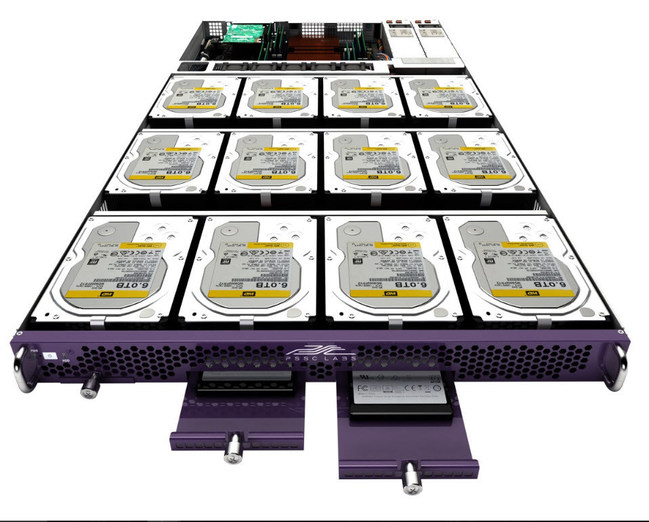
The CloudOOP 12000 now supports all flash storage that can replace the disk drives shown here, maintaining the CloudOOP 12000’s innovative design while delivering even faster analytics.

The CloudOOP 12000 now supports the new Micron 5100 series Solid State SATAIII (SSDs), with up to 14 x Micron SSDs (2 drives dedicated for operating system and 12 drives for data storage). The all flash storage option provides durability, reliability, and faster performance at a price point that makes the technology affordable to more enterprise users. The Micron SSD’s offer faster speeds that traditional non-flash storage, and when combined with the CloudOOP 12000’s made for Hadoop server, can achieves near real time performance for data analytics.

Using the largest capacity Micron SSDs, the CloudOOP 12000 can support up to 96 TBs of storage and is tailored to meet the needs of read-intensive video streaming, latency-sensitive transactional databases and write-intensive logging applications. It also makes an excellent platform for edge computing with the ability to consume large amounts of data very quickly from IOT devices and sensors.

The CloudOOP 12000 is the only server specifically designed for Hadoop, Kafka, Big Data and IOT. It offers 2x the density and up to 35% lower power draw than traditional manufacturers as well as a near 50% increase in data throughput performance. Reducing power draw means a lower data center footprint and significantly reducing your total cost of ownership with an over 90% efficiency rating.

“The CloudOOP1200 is PSSC Lab’s unique platform for enterprise users using applications like Hadoop, Spark, Kafka Streaming. PSSC Labs has already successfully deployed over 100 PBytes for Hadoop using the CloudOOP 12000 platform, and after stringent review of the SSD options on the market, we’ve certified of Micron’s new 5100 series of SSDs, which will allow us to offer our customers a high capacity, high performance, durable system with the absolute lowest cost of ownership, “said Alex Lesser, Vice President of PSSC Labs.

Micron 5100 Series SSD Features include:

High Capacity
Unique range of solutions with up to 8TB of storage in a 2.5-inch form factor and 2TB in an M.2

High Performance
Three models optimized for varying workloads with consistent, steady state random writes at 74,000 IOPS.

Secure Encryption
Built-in AES-256-bit encryption and TCG Enterprise protection with FIPS 140-2 validation – available on the 5100 MAX.

Greater Flexibility
Micron’s FlexPro firmware architecture can be used to actively tune capacity to optimize drive performance and endurance

Best Reliability
Unmatched 99.999%2 quality of service (QoS) compared to spinning media. MTTF of 2 million device hours

CloudOOP 12000 Features Include:

High Processing Power
The CloudOOP 12000 supports up to 2 x Intel Xeon E5 Series processors & up to 256GB high performance memory – get higher performance and reduced computing time

Direct Connect IO technology
Unique design gives each hard drive its own independent path to the motherboard – removing unnecessary components that restrict data pathways and improving data ingestion & IO rates.

Connectivity Options
GigE, 10GigE, 40GigE and Infiniband network connectivity options available. Dual GigE network bandwidth comes standard, with addition network adapters from Intel, Mellanox, Solarflare and others available.

Operating System Compatibility
Supports Microsoft Windows, Red Hat, CentOS, Ubuntu & most other Linux distributions.
All CloudOOP 12000 server configurations service and support from PSSC Lab’s US based, expert in house engineers. Prices for a custom CloudOOP 12000 server start at $5000.

For more information see https://pssclabs.losangeles.dev.buckupstudio.com/products/big-data-servers/.

Source: http://www.prnewswire.com/news-releases/pssc-labs-introduces-affordable-high-performance-all-flash-storage-on-unique-enterprise-server-designed-specifically-for-hadoop-300448604.html

Whitepaper: Loading a Time Series Database at 100 Million Points Per Second.

By marketing@site-a.com

There are many use cases for time series data, and they usually require handling a decent data ingest rate. Rates of more than 10,000 points per second are common and rates of 1 million points per second are not quite as common, but are certainly not unheard of.

Many of these systems are used to monitor critical infrastructure, especially at the higher data rates, where failure of the monitoring systems can lead directly to disastrous failures of the actual system.

It’s important to determine that your time series database will actually work at full loads, so naturally, many organizations will test it at full load. To do this correctly, you have to first fill the database with typically a year or 3 of data, which is where you will suddenly find yourself with a much higher data rate requirement. It makes no sense to test a system with 3 years of data if it takes 3 years to fill the database in preparation for the test.

Thus, if you have a production data rate of 100,000 points per second, you will need to ingest test data at a rate of 100 million points per second if you want to load 3 years of data in less than 2 days. Even a production rate of 10,000 points per second will require several hours to load test data.

Similarly, if you are starting a new database, you probably will want to load significant amounts of historical data, which could be just as stressful as loading the database for testing.

How did we do this?

There are three major components that should be considered:

  1. Loading one point at a time is very slow; batching must be implemented in order to accomplish faster ingestion rates.
  2. The data store needs to be highly performant in order to consistently handle such massive amounts of data.
  3. Well-configured hardware is critical to achieving the highest performance.

First, OpenTSDB was used for this test because it is a well documented time series database and it uses the HBase API for its data store. OpenTSDB also uses the non-relational nature of the HBase API to strong advantage by storing data in a hybrid wide data schema. In our tests, we used one year of data. Sampling one sensor every second for one year generates about 31.5 million points. In OpenTSDB’s storage format, this translates to about 120MB of data per sensor year of data.

Second, MapR-DB was used for this test instead of HBase itself. MapR-DB offers many benefits over HBase, while maintaining the virtues of the HBase API and the idea of data being sorted according to primary key. MapR-DB provides operational benefits such as no compaction delays and automated region splits that do not impact the performance of the database. The tables in MapR-DB can also be isolated to certain machines in a cluster by utilizing the topology feature of MapR. This allowed the testing to easily be scaled to measure the performance on any number of nodes in the cluster. The final differentiator is that MapR-DB is just plain fast, due primarily to the fact that it is tightly integrated into the MapR file system itself, rather than being layered on top of a distributed file system that is layered on top of a conventional file system.

Third, the hardware that was used was fast. The test cluster was designed by PSSC Labs specifically for use with Hadoop systems. The CloudOOP 12000 platform offers a unique, highly optimized system design with a direct data path for disk I/O for up to 12 SATA/SAS devices in a 1u rackmount chassis. This hardware explicitly lacks a raid controller and a backplane, as its intended use is for Hadoop and would otherwise be unused. Here are the specifications for this test setup:

  • Dual Intel E5-2650 v2 Processor (16 total physical cores, 32 hyper-threads)
  • 128GB DDR3 1600
  • 1 – 120GB SSD for the operating system
  • 11 – Western Digital 1TB 7200 RPM 6GB/s
  • Solarflare SFN5152 10GigE network adapter
  • CentOS 6.x
  • Estimated power draw: 240 watt idle / 325 watt 100% load

How were these numbers achieved?

Code was created by modifying portions of OpenTSDB to allow bulk importing of data. This code has been published in the MapR App Gallery and is also available via github at https://github.com/mapr-demos/opentsdb. Fundamentally what is happening is that OpenTSDB stores all points that are for a given hour into a single row in MapR-DB. During normal operations, OpenTSDB inserts each point into the row in a separate column. Once an hour, the entire row is read, columns are collected into a blob and the row is written back to the database. This results in a read and a write per point. In our bulk loading code we directly create the blob for an entire hour of data (3,600 points in our test) and insert that blob into the database in a single put. This single put takes the place of over 7,000 database operations per sensor-hour of data.

We used two edge nodes, both running code to generate and load test data. While these edge nodes were generating data, we observed near 100% CPU utilization on the edge nodes. These edge nodes were not quite hitting their outbound bandwidth limit, as they couldn’t generate data any faster than the CPU bottleneck would allow. To achieve maximum performance, we used eight separate Java virtual machines, each running two threads actively generating the data. Other configurations with more or fewer JVMs and more or fewer threads per JVM gave equal or inferior results.

We limited the output data to only four nodes out of a ten node cluster. Our original plan was to start with four nodes and increase the nodes involved in the test until we achieved our goal of more than 100 million points per second. This test generated random integers that emulated 128 sensors sampled at one second intervals for one year. This yielded over four billion points totaling about 15GB on disk storage. While this data size is less than the memory available on the test nodes, writes to the database are all fully persisted to disk during the test. The ingest rate was approximately 110 million points per second and the data load completed in about 36 seconds. The MapR-DB table was set to the default of 4GB regions, which meant that multiple region splits would occur during the tests. The data replication for the table was set to three, meaning every record was duplicated from the first server to two other servers.

At peak loading, we observed that the two edge nodes together were pushing approximately 1.5GB/s of total data from the edge nodes to the cluster nodes. Inbound data volumes on individual cluster nodes were variable, with peaks near 1.3GB/s. Impressively, the 7200 RPM disks were able to keep up with the network speed and were able to persist data with no issues. Data generation was limited by CPU capacity on the edge nodes. Ingest volume was limited by network bandwidth on the cluster side. It was clear that our loading did not drive the disk subsystems to capacity. Adding more cluster nodes will distribute the network load within the cluster, but we expect that the edge node count is the primary limit on ingestion in the current test configuration.

Could it get any faster?

The storage format of OpenTSDB is reasonable, but could be improved significantly. For instance, time values are stored in the column name for the blob of data. Using a single column name and a compressed binary representation of the data would allow substantial compression of the data. One example of this compression is in the times themselves. With delta coding, the total storage for each time in a blob format could be reduced to less than 1% of the current size. The flags which indicate the time resolution of the timestamps and whether the data is floating point could be repeated only once. For sensor data, resolution is typically limited so that dictionary encodings would likely result in up to 10x compression.

In terms of hardware, the networking bandwidth could be increased, perhaps utilizing dual 10GbE NICs or even higher-end networking gear. The MapR distribution supports transparent application level multiplexing of multiple network interfaces, allowing over 2GB/s of data to be transferred over the network. There is also a possibility that performance would improve with faster disks. These changes would increase the cost of the servers, so it would be worthwhile to understand the cost-benefit of the actual gains.

Performance could also be trivially increased by scaling the system out so that the main data table is spread across more than four nodes.